Rust 既支持了基于系统线程的多线程编程模型,也支持了基于async/await的异步编程模型。Rust 的async编程有有以下特性:
Future 在 Rust 中是惰性的 Async 在 Rust 中使用开销是零 Rust 没有内置异步调用所必需的运行时,但是社区生态中已经提供了非常优异的运行时实现,例如 tokio和async-std 运行时同时支持单线程和多线程 Rust异步编程 async/await 是 Rust 内置的语言特性,可以让我们用同步的方式去编写异步的代码。极大地简化了异步编程的复杂性。
通过async标记的语法块会被转换成实现了Future特征的状态机。 与同步调用阻塞当前线程不同,当Future执行并遇到阻塞时,它会让出当前线程的控制权,这样其它的Future就可以在该线程中运行,这种方式完全不会导致当前线程的阻塞。 await方法保证了调用异步方法的顺序,同时在执行await时,如果 future 没有 ready,线程可以挂起当前 future 任务,去执行其他 future 任务。async 编程示例 先来看个异步的例子:
1 2 3 4 5 6 7 8 9 10 11 12 13 14 15 16 17 18 19 20 21 22 23 24 25 26 27 28 29 30 31 32 33 34 35 36 37 38 39 40 41 42 use std::{thread, time::Duration};use chrono::Local;async fn async_hello_11 () { println! ( "[{}] [{:?}] hello async 11!" , Local::now ().timestamp_millis (), thread::current ().id () ); } async fn async_hello_12 () { println! ( "[{}][{:?}] hello async 12!" , Local::now ().timestamp_millis (), thread::current ().id () ); } async fn async_hello_1 () { async_hello_11 ().await ; tokio::time::sleep (Duration::from_secs (2 )).await ; async_hello_12 ().await ; } async fn async_hello_2 () { println! ( "[{}][{:?}] hello async 2 !" , Local::now ().timestamp_millis (), thread::current ().id () ); } #[tokio::main] async fn main () { let f1 = async_hello_1 (); let f2 = async_hello_2 (); tokio::join!(f1, f2); }
从输出中可以发现 3 个异步方法均在同一线程中调度执行。
1
2
3
4
5
[1747186771086] [ThreadId(1)] hello async 11! ────┬───────┐ 1ms │ [1747186771087][ThreadId(1)] hello async 2 ! ────┘ 2001ms │ [1747186773087][ThreadId(1)] hello async 12! ────────────┘
异步底层:Future 在Rust的异步编程中,Future是一个核心概念。一个Future代表了一个可能尚未完成的计算,类似于一个占位符,未来某个时刻会产生一个结果。
Future 特征 1 2 3 4 5 pub trait Future { type Output ; fn poll (self : Pin<&mut Self >, cx: &mut Context<'_ >) -> Poll<Self ::Output>; }
Future 的唯一方法是poll, 方法返回一个Poll枚举,指示Future是已完成(Ready)还是尚未完成(Pending)。poll 方法有2个参数:
self: Pin<&mut Self>: 注意 self 被 Pin 指针包装(pin确保内存中self的数据不会被移动)。Context: 运行上下文,上下文中包含了Waker,Waker用于指示Future准备好被重新调度。一旦 future 返回了 Ready,就不应该再次调用poll方法。 在多个轮询调用中,只有传递给最近调用的上下文中的waker应该被安排接收唤醒。 future 本身是惰性的,只有通过对 poll方法的调用才能推进 future 的执行。 脱糖(Async -> Future) 这里所说的脱糖并不是指 rust 会生成脱糖的代码,实际上 rust 是在llvm字节码层面实现的 async => future。所以下面的代码只是一份等效的 rust 代码。
前面提到通过async标记的语法块会被转换成实现了Future特征的状态机。接下来会一个异步函数转为使用 Future 实现的同步版本。
1 2 3 4 5 async fn foo_async (n: u64 ) { println! ("start async" ); tokio::time::sleep (Duration::from_secs (n)).await ; println! ("end async" ); }
接下来转换为一个使用 Future 特征的同步版本:
1 2 3 4 5 6 7 8 9 10 11 12 13 14 15 16 17 18 19 20 21 22 23 24 25 26 27 28 29 30 31 32 33 34 35 36 37 38 39 40 41 42 43 44 45 46 47 48 49 50 51 52 53 54 55 56 57 use std::future::Future;use std::pin::Pin;use std::task::{Context, Poll};use std::time::Duration;use tokio::time::Sleep;enum FooState { Started, Await1, Done, } struct FooFuture { state: FooState, sleep: Pin<Box <Sleep>>, } impl Future for FooFuture { type Output = (); fn poll (mut self : Pin<&mut Self >, cx: &mut Context<'_ >) -> Poll<()> { loop { match self .state { FooState::Started => { println! ("start async" ); self .state = FooState::Await1; } FooState::Await1 => match self .sleep.as_mut ().poll (cx) { Poll::Ready (_) => { self .state = FooState::Done; } Poll::Pending => { cx.waker ().wake_by_ref (); return Poll::Pending; } }, FooState::Done => { println! ("end async" ); return Poll::Ready (()); } } } } } fn foo_sync (n: u64 ) -> FooFuture { let duration = Duration::from_secs (n); let sleep = Box ::pin (tokio::time::sleep (duration)); FooFuture { state: FooState::Started, sleep, } }
Future 使用问题 递归 在内部,async fn 创建了一个包含了要.await 的子 Future 的状态机。这样递归的 async fn 有点诡异,因为结果的状态机必须包含它自身:
1 2 3 4 5 6 7 8 9 10 11 12 13 14 15 16 17 18 19 20 21 22 async fn foo () { step_one ().await ; step_two ().await ; } enum Foo { First (StepOne), Second (StepTwo), } async fn recursive () { recursive ().await ; recursive ().await ; } enum Recursive { First (Recursive), Second (Recursive), }
这不会工作——我们创建了大小为无限大的类型!编译器会报错:
1
2
3
4
5
6
7
error[E0733]: recursion in an `async fn` requires boxing --> src/lib.rs:1:22 | 1 | async fn recursive() { | ^ an `async fn` cannot invoke itself directly | = note: a recursive `async fn` must be rewritten to return a boxed future.
为了允许这种做法,我们需要用 Box 来间接调用。而不幸的是,编译器限制意味着把 recursive() 的调用包裹在 Box::pin 并不够。为了让递归调用工作,我们必须把 recursive 转换成非 async 函数,然后返回一个.boxed()的异步块。
1
2
3
4
5
6
7
8
use futures::future::{BoxFuture, FutureExt};fn recursive () -> BoxFuture<'static , ()> { async move { recursive ().await ; recursive ().await ; }.boxed () }
在 async 语句块中使用 ? async 语句块和 async fn 最大的区别就是前者无法显式的声明返回值,在大多数时候这都不是问题,但是当配合 ? 一起使用时,问题就有所不同:
1
2
3
4
5
6
7
8
9
10
11
12
13
async fn foo () -> Result <u8 , String > { Ok (1 ) } async fn bar () -> Result <u8 , String > { Ok (1 ) } pub fn main () { let fut = async { foo ().await ?; bar ().await ?; Ok (()) }; }
以上代码编译后会报错:
1
2
3
4
5
6
7
8
error[E0282]: type annotations needed --> src/main.rs:14:9 | 11 | let fut = async { | --- consider giving `fut` a type ... 14 | Ok(1) | ^^ cannot infer type for type parameter `E` declared on the enum `Result`
原因在于编译器无法推断出Result<T, E>中的 E 的类型,目前还没有办法为 async 语句块指定返回类型。既然编译器无法推断出类型,那就给它更多提示,可以使用 ::< ... >的方式来增加类型注释:
1
2
3
4
5
let fut = async { foo ().await ?; bar ().await ?; Ok::<(), String >(()) };
给予类型注释后此时编译器就知道 Result<T, E>中的 E 的类型是 String,进而成功通过编译。
async 函数和 Send 特征 对于async fn ,它返回的 Future 能否在线程间传递的关键在于 .await运行过程中,作用域中的变量类型是否是 Send。Rc 无法在多线程环境使用,原因就在于它并未实现 Send 特征,那就用它来做例子:
1
2
3
4
use std::rc::Rc;#[derive(Default)] struct NotSend (Rc<()>);
事实上,未实现 Send 特征的变量可以出现在 async fn 语句块中:
1
2
3
4
5
6
7
8
9
10
11
async fn bar () {}async fn foo () { NotSend::default (); bar ().await ; } fn require_send (_: impl Send ) {}fn main () { require_send (foo ()); }
即使上面的 foo 返回的 Future 是 Send, 但是在它内部短暂的使用 NotSend 依然是安全的,原因在于它的作用域并没有影响到 .await,下面来试试声明一个变量,然后让 .await 的调用处于变量的作用域中试试:
1
2
3
4
async fn foo () { let x = NotSend::default (); bar ().await ; }
不出所料,错误如期而至:
1
2
3
4
5
6
7
8
9
10
11
12
13
14
15
16
error: future cannot be sent between threads safely --> src/main.rs:17:18 | 17 | require_send(foo()); | ^^^^^ future returned by `foo` is not `Send` | = help: within `impl futures::Future<Output = ()>`, the trait `std::marker::Send` is not implemented for `Rc<()>` note: future is not `Send` as this value is used across an await --> src/main.rs:11:5 | 10 | let x = NotSend::default(); | - has type `NotSend` which is not `Send` 11 | bar().await; | ^^^^^^^^^^^ await occurs here, with `x` maybe used later 12 | } | - `x` is later dropped here
提示很清晰,.await在运行时处于 x 的作用域内。.await有可能被执行器调度到另一个线程上运行,而 Rc 并没有实现 Send,因此编译器报错。为了规避这个问题,你可能需要引入一个块作用域来封装任何非 Send 变量。这会让编译器更容易发现这些变量不会存活超过.await 点。
1
2
3
4
5
6
async fn foo () { { let x = NotSend::default (); } bar ().await ; }
Delay future 了解 Future 特征后,我们实现一个非常简单的 future – 延时执行
1
2
3
4
5
6
7
8
9
10
11
12
13
14
15
16
17
18
19
20
21
22
23
24
25
26
27
28
29
30
31
32
use std::future::Future;use std::pin::Pin;use std::task::{Context, Poll};use std::time::{Duration, Instant};struct Delay { when: Instant, } impl Future for Delay { type Output = &'static str ; fn poll (self : Pin<&mut Self >, cx: &mut Context<'_ >) -> Poll<&'static str > { if Instant::now () >= self .when { println! ("Delay complete" ); Poll::Ready ("done" ) } else { cx.waker ().wake_by_ref (); Poll::Pending } } } #[tokio::main] async fn main () { let when = Instant::now () + Duration::from_secs (2 ); let future = Delay { when }; let out = future.await ; assert_eq! (out, "done" ); }
在返回 Poll::Pending 之前,我们调用了 cx.waker().wake_by_ref()。这是为了满足 future 约定。通过返回 Poll::Pending,我们有责任发出 waker 信号。在上面的实现中内联发出了 waker 信号。这样做将导致 future 立即重新调度、再次执行,并且可能尚未准备好完成。在这种特定情况下,即使我们根本没有准备好继续操作,我们也发出了 waker 信号。除了浪费一些 CPU 周期外,这没有什么问题。但是,此特定实现将导致忙循环。
我们可以更新 Delay,确保完成时才 wake。
1
2
3
4
5
6
7
8
9
10
11
12
13
14
15
16
17
18
19
20
21
22
23
24
25
26
27
28
29
30
31
32
33
34
35
36
37
use std::future::Future;use std::pin::Pin;use std::task::{Context, Poll};use std::time::{Duration, Instant};use std::thread;struct Delay { when: Instant, } impl Future for Delay { type Output = &'static str ; fn poll (self : Pin<&mut Self >, cx: &mut Context<'_ >) -> Poll<&'static str > { if Instant::now () >= self .when { println! ("Hello world" ); Poll::Ready ("done" ) } else { let waker = cx.waker ().clone (); let when = self .when; thread::spawn (move || { let now = Instant::now (); if now < when { thread::sleep (when - now); } waker.wake (); }); Poll::Pending } } }
上面的计时器版本实现咋一看没有问题,但是需要注意的是,Rust 的异步模型允许单个 future 在执行时跨任务迁移。考虑以下情况:
1
2
3
4
5
6
7
8
9
10
11
12
13
14
15
16
17
18
19
20
use futures::future::poll_fn;use std::future::Future;use std::pin::Pin;#[tokio::main] async fn main () { let when = Instant::now () + Duration::from_millis (10 ); let mut delay = Some (Delay { when }); poll_fn (move |cx| { let mut delay = delay.take ().unwrap (); let res = Pin::new (&mut delay).poll (cx); assert! (res.is_pending ()); tokio::spawn (async move { delay.await ; }); Poll::Ready (()) }).await ; }
poll_fn 函数使用闭包创建一个 Future 实例。上面的代码片段创建了一个 Delay 实例,轮询一次,然后将 Delay 实例发送到一个新任务,并在其中进行 await 操作。在此示例中,使用不同的 Waker 实例多次调用 Delay::poll。发生这种情况时,您必须确保在传递给最近一次 poll 调用的 Waker 上调用 wake。在实现 future 时,至关重要的是要假设每次调用 poll 可能会提供不同的 Waker 实例。poll 函数必须使用新的 waker 更新任何先前记录的 waker。
同时,上面的Delay 实现每次轮询时都会衍生一个新的线程。这很好,但如果轮询过于频繁(例如,如果您在 future 和其他 future 上使用 select!,则每当其中任何一个发生事件时都会轮询两者),则效率会非常低。
针对上面的两个问题: 一种方法是记住您是否已经衍生了一个线程,并且仅在您尚未衍生线程时才衍生一个新线程。但是,如果您这样做,则必须确保在后续的 poll 调用中更新线程的 Waker,否则您将不会唤醒最近的 Waker。
1
2
3
4
5
6
7
8
9
10
11
12
13
14
15
16
17
18
19
20
21
22
23
24
25
26
27
28
29
30
31
32
33
34
35
36
37
38
39
40
41
42
43
44
45
46
47
48
use std::future::Future;use std::pin::Pin;use std::sync::{Arc, Mutex};use std::task::{Context, Poll, Waker};use std::thread;use std::time::{Duration, Instant};struct Delay { when: Instant, waker: Option <Arc<Mutex<Waker>>>, } impl Future for Delay { type Output = (); fn poll (mut self : Pin<&mut Self >, cx: &mut Context<'_ >) -> Poll<()> { if Instant::now () >= self .when { return Poll::Ready (()); } if let Some (waker) = &self .waker { let mut waker = waker.lock ().unwrap (); if !waker.will_wake (cx.waker ()) { *waker = cx.waker ().clone (); } } else { let when = self .when; let waker = Arc::new (Mutex::new (cx.waker ().clone ())); self .waker = Some (waker.clone ()); thread::spawn (move || { let now = Instant::now (); if now < when { thread::sleep (when - now); } let waker = waker.lock ().unwrap (); waker.wake_by_ref (); }); } Poll::Pending } }
当然我们还可以使用tokio::sync::Notify来实现 delay。Notify 提供基本的任务通知机制。它处理 wakers 的细节,包括确保记录的 waker 与当前任务匹配。
1
2
3
4
5
6
7
8
9
10
11
12
13
14
15
16
17
18
19
use tokio::sync::Notify;use std::sync::Arc;use std::time::{Duration, Instant};use std::thread;async fn delay (dur: Duration) { let when = Instant::now () + dur; let notify = Arc::new (Notify::new ()); let notify_clone = notify.clone (); thread::spawn (move || { let now = Instant::now (); if now < when { thread::sleep (when - now); } notify_clone.notify_one (); }); notify.notified ().await ; }
同时执行多个 Future 通常使用.await 来执行future,但是这会阻塞并发任务,直到特定的 Future 完成。然而,真实的异步应用经常需要并发执行几个不同的操作。
join! futures::join宏等待并发执行的多个不同 future 完成。
1
2
3
4
5
6
7
use futures::join;async fn get_book_and_music () -> (Book, Music) { let book_fut = get_book (); let music_fut = get_music (); join!(book_fut, music_fut) }
对于那些返回 Result 的 future,考虑使用 try_join! 而非 join。因为 join 只会在所有子 future 都完成后才会完成,它甚至会在子 future 返回 Err 之后继续处理。与 join! 不同,try_join! 会在其中的子future返回错误后立即完成。
select! join!只有等所有 Future 结束后,才能集中处理结果,如果你想同时等待多个 Future ,且任何一个 Future 结束后,都可以立即被处理,可以考虑使用 futures::select!。
1
2
3
4
5
6
7
8
9
10
11
12
13
14
15
16
17
18
19
20
use futures::{ future::FutureExt, pin_mut, select, }; async fn task_one () { }async fn task_two () { }async fn race_tasks () { let t1 = task_one ().fuse (); let t2 = task_two ().fuse (); pin_mut!(t1, t2); select! { () = t1 => println! ("任务1率先完成" ), () = t2 => println! ("任务2率先完成" ), } }
select!还支持 default 和 complete 分支:
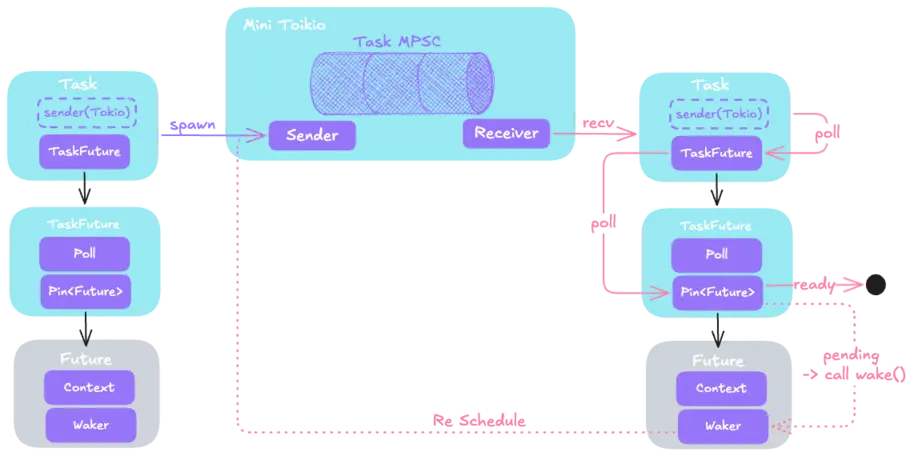
complete 分支当所有的 Future 和 Stream 完成后才会被执行,它往往配合 loop 使用,loop 用于循环完成所有的 Future default 分支,若没有任何 Future 或 Stream 处于 Ready 状态, 则该分支会被立即执行 mini 运行时 要运行异步函数,必须通过 poll 函数调用。而最外层的 Future 是通过异步运行时调度的。接下来我们将实现一个最小运行时。
工程级别的tokio运行时调度器
RunTime 1 2 3 4 5 6 7 8 9 10 11 12 13 14 15 16 17 18 19 20 21 struct MiniTokio { scheduled: mpsc::Receiver<Arc<Task>>, sender: mpsc::Sender<Arc<Task>>, } impl MiniTokio { fn run (&self ) { while let Ok (task) = self .scheduled.recv () { task.poll (); } } fn new () -> MiniTokio { let (sender, scheduled) = mpsc::channel (); MiniTokio { scheduled, sender } } fn spawn <F>(&self , future: F) where F: Future<Output = ()> + Send + 'static , { Task::spawn (future, &self .sender); } }
Task 1 2 3 4 5 6 7 8 9 10 11 12 13 14 15 16 17 18 19 20 21 22 23 24 25 26 27 28 29 30 31 32 33 34 35 36 37 38 39 40 41 42 43 44 45 46 47 48 49 50 51 52 53 54 55 56 57 58 59 60 61 struct Task { task_future: Mutex<TaskFuture>, executor: mpsc::Sender<Arc<Task>>, } impl ArcWake for Task { fn wake_by_ref (arc_self: &Arc<Self >) { arc_self.schedule (); } } impl Task { fn schedule (self : &Arc<Self >) { self .executor.send (self .clone ()); } fn poll (self : Arc<Self >) { let waker = task::waker (self .clone ()); let mut cx = Context::from_waker (&waker); let mut task_future = self .task_future.try_lock ().unwrap (); task_future.poll (&mut cx); } fn spawn <F>(future: F, sender: &mpsc::Sender<Arc<Task>>) where F: Future<Output = ()> + Send + 'static , { let task = Arc::new (Task { task_future: Mutex::new (TaskFuture::new (future)), executor: sender.clone (), }); let _ = sender.send (task); } } struct TaskFuture { future: Pin<Box <dyn Future<Output = ()> + Send >>, poll: Poll<()>, } impl TaskFuture { fn new (future: impl Future <Output = ()> + Send + 'static ) -> TaskFuture { TaskFuture { future: Box ::pin (future), poll: Poll::Pending, } } fn poll (&mut self , cx: &mut Context<'_ >) { if self .poll.is_pending () { self .poll = self .future.as_mut ().poll (cx); } } }
使用 1 2 3 4 5 6 7 8 9 10 11 12 13 fn main () { let mut mini_tokio = MiniTokio::new (); mini_tokio.spawn (async { let when = Instant::now () + Duration::from_millis (10 ); let future = Delay { when }; let out = future.await ; assert_eq! (out, "done" ); }); mini_tokio.run (); }
阻塞 vs 非阻塞 async/await的异步编程是非阻塞的,适合 I/O bound的任务,通过让出目前的协程调度,执行下一个任务的方式,来消除ContextSwitch上的开销。协程适用于被阻塞的,且需要大量并发的场景。但不适用于大量计算的多线程,
考虑下面两种情况:
昂贵的CPU-Bound(受限于CPU资源的)计算 同步IO(Synchronous IO)操作 在这两种情况下,我们都在处理一个会在一段时间内阻止任务.await的操作。为了解决这个问题,我们必须将阻塞操作移动到Tokio线程池外部的线程中去。关于这一点有三种形式可以使用:
使用tokio::task::spawn_blocking函数Tokio运行时包含一个单独的线程池,专门用于运行阻塞函数,你可以使用 spawn_blocking在其上运行任务。这个线程池的上限是大约500个线程,因此可以在这个线程池上进行大量阻塞操作。由于线程池有如此多的线程,它最适合用于阻塞 I/O (如与文件系统交互)或使用阻塞数据库库(如diesel)。 线程池不适合昂贵的CPU-bound计算,因为线程池的线程数量比计算机上的 CPU核心数量多得多。当线程数等于CPU核心数时,CPU-bound的计算运行效率最高。 使用rayon craterayon提供了一个专门用于昂贵的CPU-bound计算的线程池(与 tokio 相比,rayon的线程池的最大线程数量很少) 通过std::thread::spawn创建一个专门的线程如果阻塞操作是需要永久运行下去的,那么应该在专用线程上运行它。例如,考虑一个管理数据库连接的线程,他需要使用通道来接收要执行的操作。因为这个线程在循环中监听该通道,所以它永远不会退出。 在上述两个线程池中的任何一个上运行这样的任务都会是一个问题,因为它实际上从池中永久地带走了一个线程。一旦这样做了几次,线程池中就没有更多的线程了,所有其他阻塞任务都无法执行。 长尾延迟 1 2 3 4 5 6 7 let mut listener = TcpListener::bind (&addr).await ?;loop { let (mut socket, _) = listener.accept ().await ?; tokio::spawn (async move { }); }
Rust编译器将上面的代码转换为状态机。运行时复用少数线程执行这些状态机任务。每一个.await调用是将控制权返回给调度器的机会。在上面的示例中,listener.accept().await将返回一个挂起的套接字。如果没有挂起的套接字,则将控制权交还给调度程序。
1 2 3 4 5 6 7 8 9 10 11 tokio::spawn (async move { let mut buf = [0 ; 1024 ]; loop { let n = socket.read (&mut buf).await ?; if n == 0 { break ; } socket.write (buf[..n]).await ?; } });
read().await 在等待数据的时候让出控制权数据到达,任务恢复 write().await在写入套接字时让出控制权写完成,任务恢复 立即循环回read() 如果接收数据的速度比处理数据的速度快,那么在数据块处理完成之前,可能已经接收了更多的数据。此时,read().await可能会立刻返回不让出控制权。然后循环下去,也不会让出控制权给调度器。导致以下结果:
同一运行时线程上的其他任务 饥饿 延迟差异大:一些请求立即得到处理,而另一些请求等待的时间比应该等待的时间长得多 公平性差:当前任务独占CPU时间。 tokio: yield_now Tokio的用户可以在应用程序和库中添加yield_now()来解决这个问题。
在实践中,很少有人真正这样做,最终容易受到这种问题的影响。
1 2 3 4 5 6 7 8 9 10 11 12 13 14 15 16 tokio::spawn (async move { let mut buf = [0 ; 1024 ]; loop { let n = socket.read (&mut buf).await ?; if n == 0 { break ; } socket.write_all (&buf[..n]).await ?; task::yield_now ().await ; } });
这个问题的常见解决方案是抢占。对于普通的操作系统线程,内核会经常中断执行,以确保所有线程的公平调度。完全控制执行的运行时(Go、Erlang等)也会使用抢占来确保任务的公平调度。这是通过注入yield点来实现的 —— 代码检查任务是否已经执行了足够长的时间,如果是,则在编译时返回给调度程序。不幸的是,Tokio无法使用这种技术,因为Rust的async生成器没有为执行器(如Tokio)提供任何注入这种yield点的机制。
Tokio:Per-task operation budget 即使Tokio无法抢占,仍然有机会推动一个任务yield。截至0.2.14,每个Tokio任务都有一个操作预算。当调度程序切换到任务时,这个预算会被重置。每个Tokio资源(套接字、计时器、通道、…)都知道这个预算。只要任务还有预算剩余,资源就会像以前一样运行。
每个异步操作(用户等待的操作 - .await)减少任务的预算。一旦任务超出预算,所有Tokio资源将永远返回Not Ready,直到任务返回给调度器。在这一点上,预算被重置,在Tokio资源上.await的 future将再次正常运行。
以上面的 socket 代码为例,当socket.read(..)和socket.write(..)被调用时,预算会递减。如果预算为零,则任务会返回给调度程序。如果read或write由于底层套接字没有准备好(没有待处理的数据或完整的发送缓冲区)而无法继续,则任务也会返回给调度程序。
参考资料